
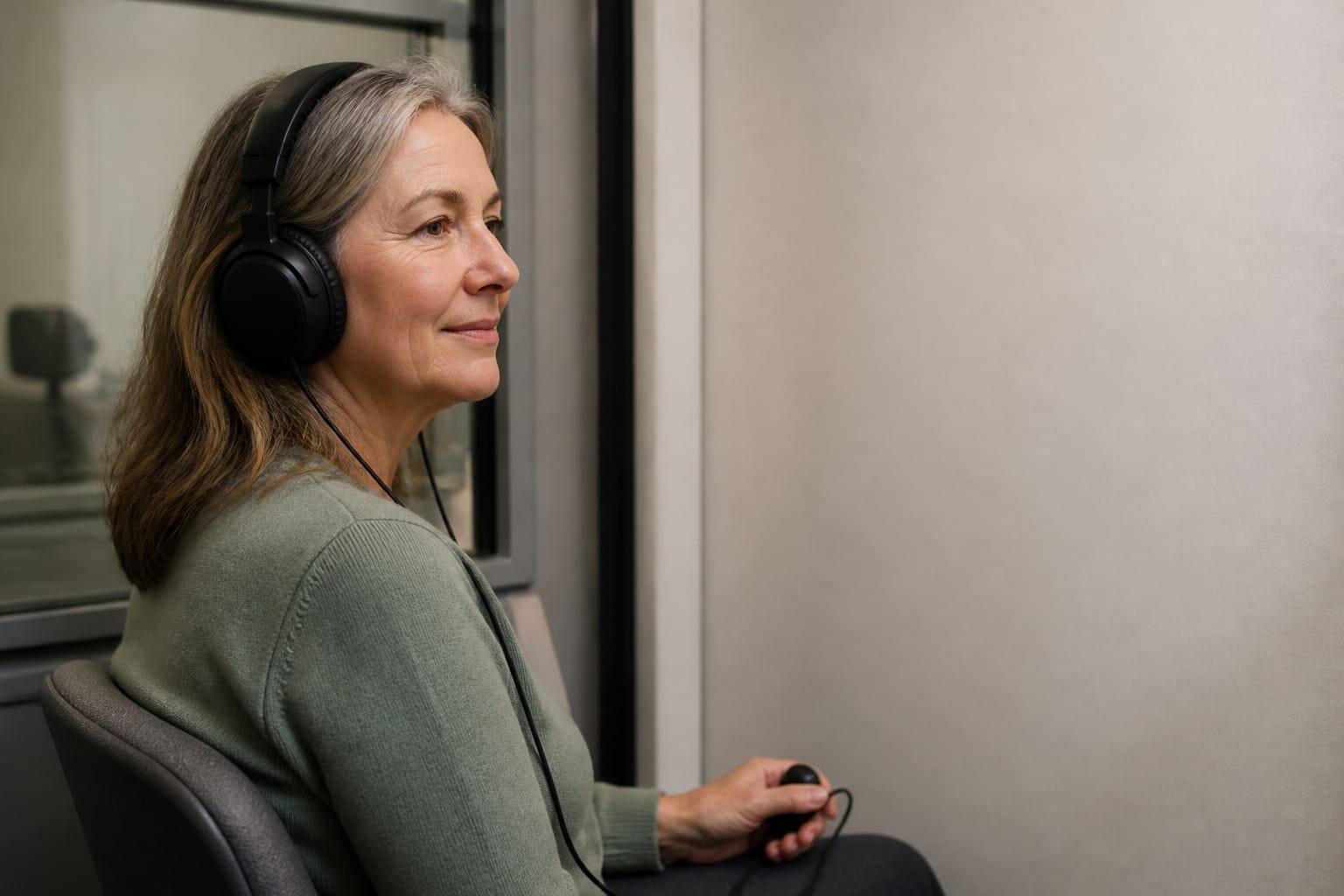

Your hearing test results can give you a clear number for how well you can hear each type of sound. The number represents how well you hear on the day of the test, in the test environment. This information can change in various ways.
What A Hearing Test Actually Measures
A standard hearing test includes pure-tone hearing tests. Pure-tone hearing tests measure your hearing for a range of different frequencies by playing pure tones of varying volumes and asking you to indicate when you can hear a tone. A graph is then plotted with your results, indicating your hearing threshold levels for each frequency tested. Note that this test does not test for all types of ear problems, and results from this test will only give an indication of your hearing sensitivity for the tested frequencies.
Why The Testing Room Matters
A hearing test is carried out in a soundproof booth to help ensure that the quietest sounds you can just about hear are not masked by background noise, such as the hum of a fan, or traffic outside the test centre. Although many Hearing Tests are now carried out in clinics, and there are many simple online hearing tests available to take in your own home, it is very important that a Hearing Test Bristol appointment is carried out in a quiet soundproof booth to provide the most accurate results possible.
How Earwax Or A Cold Can Skew Things
There are a number of reasons why your results could be affected temporarily. For example, a recent cold, an ear infection or even a full ear of earwax can all affect your results and give a false impression of your true hearing ability. Sometimes a simple visit to the GP or local pharmacy to have your ear wax cleaned out can solve the problem and you will find your hearing returns to normal within a few days. It’s also worth bearing in mind that you may have an ear infection or even a cold and not even realise it. If you have got a sore or blocked ear then it’s worth waiting a week or so before coming for your hearing test.
Why The Day Before A Test Counts
Temporary threshold shifts can be caused by loud noise such as listening to music, or by work in noisy environments, or even by simple tiredness. A few days rest from such activities can return hearing to normal. It is also worth remembering that late night listening to music via headphones can affect the results of hearing tests. This is because hearing needs a few hours of rest at night in order to recover from the day’s activities. Therefore it is wise to avoid listening to music via headphones the night before a hearing test.
Why Equipment Calibration Matters
The audiometer used to test hearing needs to be checked for accuracy regularly. A small change in the amount of sound an audiometer produces can affect results. This is one of the reasons that results obtained in different clinics may vary from one day to another even though the testing is being conducted on the same day. It’s something that any reputable hearing service would service their equipment in accordance with a predetermined schedule.
Why Two Different Tests Are Used Together
A pure-tone hearing test looks at how quietly you can hear different frequencies, but this does not always correlate with how you would manage with speech in different situations. Many hearing tests are now accompanied by a speech-in-noise test, which looks at how you would manage with conversation in different situations. A full description of how pure-tone hearing tests are carried out is available on the NHS website. For more information on how to get a hearing test, please see the RNID website.
Why Results Can Shift Between Visits
Normal variation between two hearing tests carried out several weeks apart would be small changes of a few decibels at individual frequencies. Significant changes to hearing would be described as being of a greater magnitude, being more consistent across a range of test frequencies and possibly correlated with other changes that you may have noticed in your hearing. We also need to be able to rely on repeat hearing tests after we have provided hearing aid(s) for our patients. As such, the regulation of hearing aid devices requires that accurate and repeatable test data is obtained.
When It’s Worth Repeating A Test
A few instances where a retest is more suitable than accepting a single result are when you have recently suffered from a cold or inner ear infection and the test is due to be repeated once your illness has cleared up. If you have recently had your ear wax cleaned then a retest is also suitable. If for any other reason your test results do not reflect how you really hear then it is always worth having another test done. Even if your test results come back within normal limits and you understand why you have been tested, it is always worth getting a second opinion if you are getting other people to repeat things that you just can’t hear. If you are a resident of Bristol looking for local health services to test your hearing then most of the audiology services will be happy to test you on another occasion.
A single hearing test result may not be completely accurate but it is usually a fair snapshot of the hearing on the day of the test. It’s always worth having another test if you’re unsure about your results and they don’t reflect how you actually hear.