
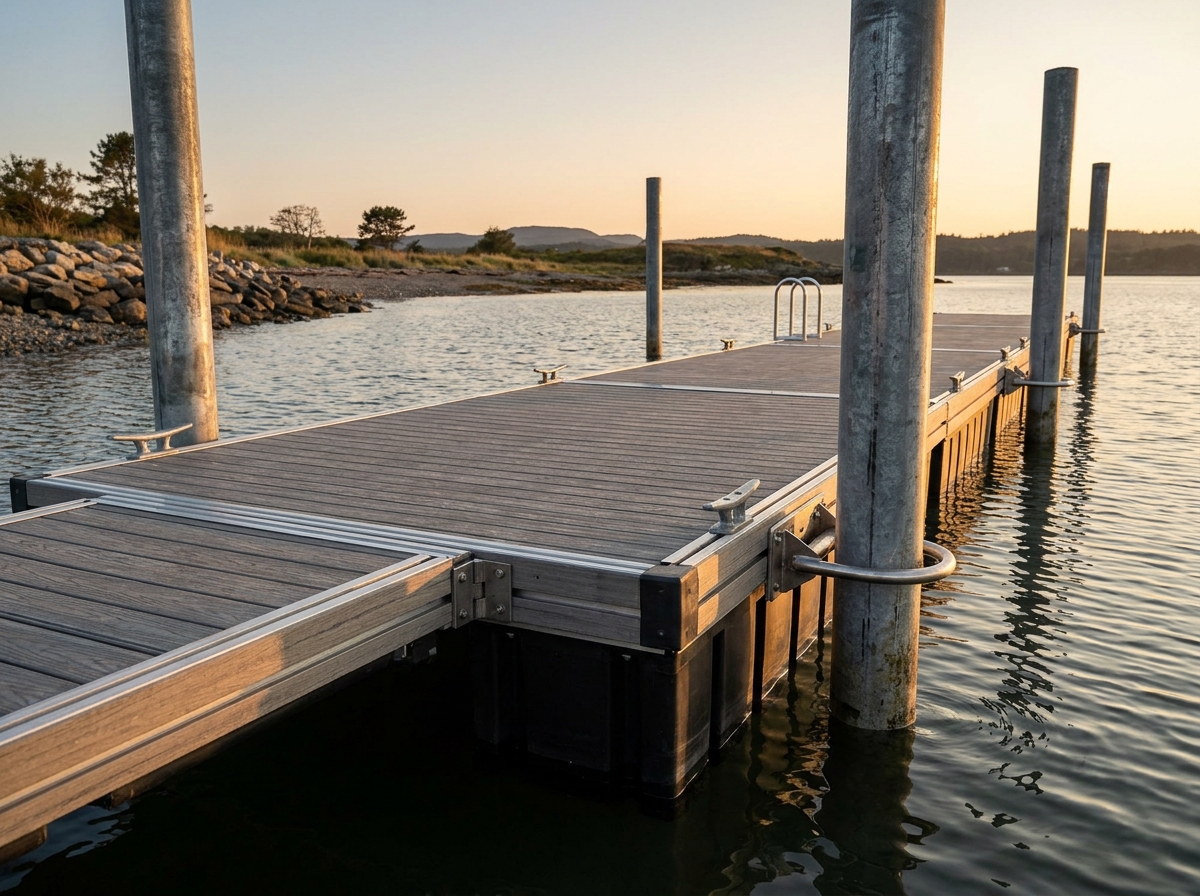

A floating dock should feel steady enough for people to walk, board boats, and move equipment without worrying about excessive tilting or shifting. Although some movement is normal, a dock that rocks too much or drifts out of position can become difficult to use. Keeping the structure level and secure depends on several design details working together, from the flotation beneath the platform to the way it connects to shore.
Keeping the Dock Level Starts With Proper Flotation Placement
Flotation units provide the upward force that supports a floating dock and everything placed on it. Their size, number, and location determine how evenly the platform sits in the water. Poorly positioned floats can leave corners or walkways without enough support, causing certain sections to dip when people step onto them.
Weight distribution also affects stability. Heavy equipment, storage compartments, and groups of passengers can place greater loads on one side of the dock. A properly designed aluminum floating dock accounts for these differences by spreading flotation support across the areas that need it. Buyers comparing aluminum boat docks for sale should ask about usable load capacity and whether the flotation arrangement suits their intended activities.
What Keeps a Floating Dock From Drifting Out of Position?
Anchoring systems must control sideways movement while allowing the platform to rise and fall with changing water levels. Cables, guide piles, and rigid anchoring arms accomplish this in different ways. Their suitability depends on water depth, lakebed conditions, shoreline slope, and exposure to waves.
Loose anchors can allow excessive drifting, but overly restrictive connections create problems too. If the structure cannot move as intended, changing water levels may place unnecessary pressure on attachment points. Experienced floating dock builders calculate the expected range of movement and select anchoring arrangements accordingly. Cable angles, attachment locations, and anchor holding capacity all influence how securely the platform stays in position during normal boating conditions.
A Strong Frame Helps Prevent Uneven Movement
Even with adequate flotation, a poorly supported frame may bend or twist as weight shifts across the deck. Structural beams and crossmembers distribute these loads throughout the platform, helping individual sections remain properly aligned. Spacing matters because large unsupported areas can flex excessively under concentrated weight.
Aluminum boat docks use lightweight, corrosion-resistant framing, but material quality alone does not guarantee structural strength. Beam dimensions, alloy selection, and connection methods must match the expected loads. Designers also consider how repeated wave movement affects welded joints and mounting brackets.
Proper reinforcement becomes especially important around corners, gangway connections, and areas supporting heavy accessories. Owners comparing aluminum docks for sale should look beyond the overall dimensions and ask how the frame handles uneven loading and repeated movement.
Connections Need Flexibility Without Becoming Loose
Floating platforms often consist of connected sections that move slightly differently as waves pass underneath. Hinges and joining hardware must accommodate that motion without allowing excessive separation, twisting, or impact between sections. Connections that are too rigid can transfer unnecessary stress into the frame, while worn hardware may allow neighboring platforms to sit unevenly.
Regular inspection helps identify developing problems around bolts, brackets, and mounting holes. Unusual clicking sounds, widening gaps, or connections that repeatedly loosen may indicate wear rather than ordinary dock movement. Well-designed aluminum docks provide access to these components so owners can arrange repairs without dismantling large portions of the structure.
How Shoreline Conditions Affect Long-Term Dock Stability
Waterfront conditions can change significantly throughout the year, affecting how a dock behaves even when its main components remain sound. Falling water levels may reduce clearance beneath the platform, while storms can shift debris or place additional pressure on anchoring equipment. Shallow areas can also cause portions of a dock to contact the lakebed, leaving other sections floating unevenly.
Site measurements help determine the appropriate platform arrangement, anchoring method, and access walkway. Flotation Systems manufactures custom aluminum floating dock systems with configurations designed for different waterfront conditions. Its available anchoring options and platform designs give property owners a way to address shoreline depth, water-level changes, and expected dock use before installation. Those details can make a noticeable difference in keeping a floating structure properly positioned and comfortable to use.
