

How long does concrete take to set? A slow set can throw a spanner in the works of a busy programme, and you may return to site to find that the pour has not yet gained sufficient strength to strip the forms.
Cold Air and Ground Temperature
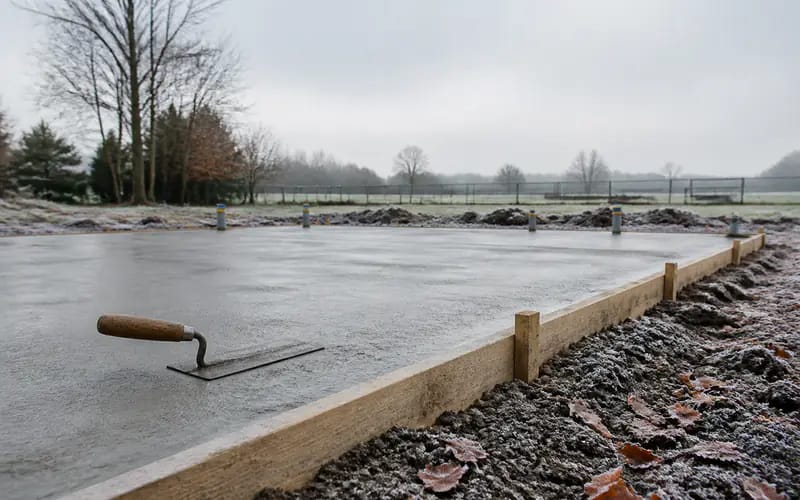
A slow set can be caused by a slow hydration reaction, which can be slowed down by cold temperatures. Below about 5°C the hydration reaction can almost come to a standstill, hence the longer setting time of winter concretes. The temperature of the ground also has an affect on the setting of concrete, as heat can be drawn out of the concrete from below. As with the air temperature, it is worth checking the Met Office weather forecast for the site prior to a late-autumn or winter pour, to assess the ground temperature as well as the air temperature.
Too Much Water in the Mix
More water in the concrete mix can lead to slower development of strength. However, easier pouring and finishing of surfaces is provided. Fresh concrete needs time for the water to evaporate or for it to be consumed in the chemical processes of hydration. With a high water-cement ratio as found in a wetter mix, the time for the concrete to harden properly will be longer.
The Type of Cement Used
While the majority of concrete mixes made with CEM I cement can be expected to set in reasonably quick time, there are other types available, which can set at a much slower rate, releasing strength over a longer period of time. These types of cement are specifically designed to promote a much cleaner environment, and to aid in large pours. If your supplier has specified the use of GGBS (ground granulated blast furnace slag) or fly ash then a slower set is expected.
Pour Thickness and Mass
The thinner section of pour such as a path or shed base will lose heat quickly to the surrounding air. However, the thick foundations and footings of larger pours such as large extensions will hold the heat from the hydration reaction within the concrete core of the pour and can even feel warm to touch within a few hours of placement.
Retarding Admixtures
There is also the possibility that a retarding admixture has been added to your concrete. This can happen for a number of reasons including allowing a longer work time on site or to allow the concrete to set more slowly during long transports. It is worth calling your supplier and asking if any retarder has been added to your mix. As with all the above points, if this is the case then the mix was designed to perform in this manner.
Damp, Humid or Wet Site Conditions
For a Gloucester delivered concrete, site conditions can change quickly and damp/humid site conditions will mean that the surface of a newly poured slab will remain workable for a longer period. This can be good in that you have more time to finish and provide a good quality surface but do not mistake surface drying with underlying strength gain.
Wind Chill on an Exposed Pour
One of the key factors for curing concrete is the temperature of the air and ground around it. This is why it is worth checking the Met Office weather forecast for low temperatures. Also, wind chill has to be taken into account for an open site as this will pull heat from the surface of the concrete. Blankets or even sheets of polythene can be used to cover a fresh pour and allow it to retain the heat that it generates.
Practical Checks to Make
In covering freshly laid concrete with insulated blankets or even covering with polythene sheets overnight, particularly in cold weather, you can ensure that the laitance that is being produced by the curing concrete is not lost. It is also very helpful in ascertaining the constituents of the concrete, and in particular, the admixtures, that have been added to the fresh concrete to ensure that you can determine the most likely cause of any slow set. If you are looking for Concrete Gloucester, see https://www.monstermixconcrete.co.uk/. Just remember, the concrete may need to be left for longer than you first thought. Do not rush to start loading, finishing or even stripping the formwork too soon.
These factors can occur singularly or in combination, and it is usually the cumulative effect of a few of these that cause concern. By allowing the concrete the time it needs and by protecting it from the elements, it will eventually reach the required strength.
