
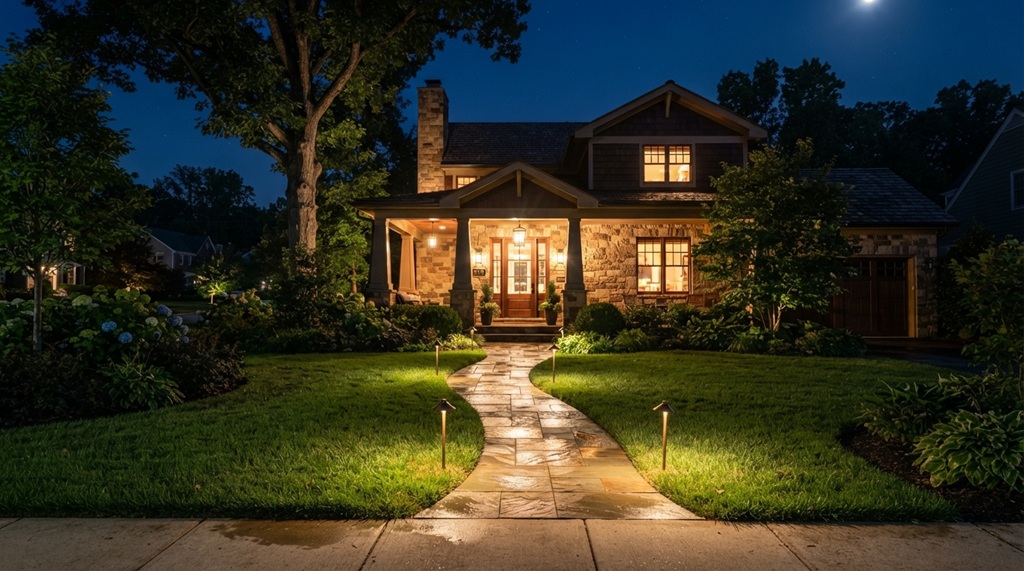

Maryland’s distinct four-season climate, ranging from humid Chesapeake Bay summers to icy, windy winters, presents unique challenges for landscape lighting. Choosing the wrong outdoor pathway lights for Maryland homes can lead to rusted fixtures, flickering bulbs, and dangerous icy walkways within just a year or two. Homeowners often focus solely on brightness or aesthetics, overlooking critical factors like salt-air corrosion resistance and cold-weather battery performance. This guide cuts through the noise, providing a practical framework for selecting fixtures that are durable, safe, and visually appealing for the specific realities of the Old Line State. We will cover material science, lighting temperatures, placement strategies, and code considerations to ensure your investment lasts for decades.
Key Takeaways
- Prioritize IP65+ and marine-grade materials: Maryland’s humidity and coastal salt require aluminum or stainless steel fixtures with high Ingress Protection ratings to prevent corrosion.
- Match light color to the season: Use warm 2700K LEDs for year-round ambiance; they handle snow glare better than stark cool white lights.
- Low-voltage is the safety standard: For DIY installation, 12V systems are safer and more energy-efficient than line-voltage (120V) options, especially on wet lawns.
- Elevate fixtures for snow removal: Choose bollard or stake lights that sit at least 12 inches above grade to avoid being buried or damaged by plows and shovels.
- Zoning and controls matter: Look for fixtures compatible with timers or photocells to manage the long, dark winter evenings efficiently.
Why Maryland’s Climate Demands Specific Pathway Lighting
Selecting pathway lights isn’t just about picking the prettiest catalog photo. The Mid-Atlantic region has a punishing cycle of freeze-thaw, high humidity, and severe storms. A fixture rated for a dry Arizona climate won’t survive a single Ocean City winter. The primary failure points in Maryland are moisture ingress (water seeping into the housing) and thermal stress (plastic becoming brittle in cold). For homeowners researching outdoor pathway lights maryland homes, the focus must shift from “decorative” to “weather-rated structural.” Look for fixtures with rubber gaskets, sealed lens housings, and powder-coated finishes—not painted surfaces that chip and rust.
The Hidden Danger of Coastal Salt
If you live near the Bay or the Atlantic, standard “galvanized” steel is a trap. The salt air will eat through the zinc coating rapidly. Instead, opt for 316L stainless steel or copper. These materials resist chloride corrosion and develop a patina rather than rust. Even inland, the salt used to de-ice driveways in Montgomery and Frederick counties splashes onto fixtures and seeps into the soil, accelerating corrosion of buried mounting stakes.
Bulb Types and Brightness: Visibility vs. Glare
In Maryland, path lighting serves a dual purpose: guiding guests and preventing slips on wet leaves or black ice. The number one mistake is over-lighting. Bright, glaring downlights cause deep shadows—exactly where ice hides. The ideal pathway light uses a shielded, downward-facing LED to create a “pool of light” on the ground. Lumens are your primary metric; you need roughly 50 to 100 lumens per fixture for a residential walkway. Anything brighter looks like a runway at BWI Airport.
CCT: Warm vs. Cool White
Color Correlated Temperature (CCT) is measured in Kelvin. For Maryland’s autumn evenings, stick to 2700K to 3000K (warm white). This creates a welcoming glow that contrasts well with fall foliage and greenery. Cool white (4000K+) washes out skin tones and makes snow look grey. Furthermore, warm light attracts fewer insects—a crucial factor during Maryland’s humid mosquito season in August.
Hardwired vs. Solar vs. Low-Voltage: The Real Trade-offs
Choosing a power source is the most significant decision. Let’s break down the three main options with specific consideration for Maryland conditions.
Low-Voltage (12V-14V): The Goldilocks Option
For most residential settings, a transformer-powered low-voltage system is the best investment. The power supply plugs into an outdoor GFCI outlet and steps voltage down to 12 volts. This reduces shock risk and allows for halogen or LED bulbs. In Maryland, a 120-watt transformer is usually sufficient, but you must account for voltage drop over long runs—keep wire runs under 100 feet to prevent dimming at the end of the line. These systems handle freezing rain better than solar because they are not dependent on daylight recharge.
Solar: Convenient but Inconsistent
Solar fixtures have improved, but they struggle with Maryland’s heavy tree canopies and overcast winter days. A solar light placed under a maple tree may get 30% of its optimal charge. Furthermore, the internal batteries degrade in cold temps, often turning the light off by 9 PM during December—just when visibility is needed most. If you choose solar, buy units with detachable panels so you can mount the panel in the sun and the light in the shade.
Line Voltage (120V): Professional Grade
These are the most durable but require conduit, waterproof wire nuts, and often a licensed electrician (per Maryland state code). They offer the highest brightness but are overkill for standard suburban pathways. Use line voltage only for long, commercial-grade drives where extreme brightness is required.
Material Selection: Fighting the Elements
The housing material dictates lifespan. The “Big 3” for Maryland are Aluminum, Stainless Steel, and Brass.
| Material | Corrosion Resistance | Best For | Watch Outs |
|---|---|---|---|
| Die-Cast Aluminum | High (with powder coat) | General use, budget-friendly | Paint chips; must be primed & sealed |
| 316L Stainless Steel | Very High (Salt-proof) | Coastal areas near the Bay | Expensive; can heat up in direct sun |
| Solid Brass | Excellent (Patina forms) | Historic districts (Annapolis, Ellicott City) | High cost; heavier mounting required |
Avoid plastic (polycarbonate) bases if possible. While cheap, they become brittle in the freeze-thaw cycle and crack when struck by a snow shovel.
Strategic Placement Strategies for Outdoor Pathway Lighting
Proper fixture placement balances physics and human perception, transforming a dark landscape into an inviting, secure entryway. Spacing lights too far apart creates dangerous visual gaps—or “black holes”—that compromise safety by hiding foot hazards and potential security risks. When designing a cohesive illumination plan for your entire property, it is essential to harmonize both interior and exterior environments; for instance, while low-voltage landscape fixtures optimize curb appeal and walkway safety outdoors, top-floor renovations demand a distinct approach—if you are currently enhancing your indoor layout as well, explore these tips for lighting a loft conversion to achieve seamless, balanced light throughout your home.
The Rule of Thumb Offsets
For a standard 3-4 foot wide walkway, stagger the lights on opposite sides rather than lining them up directly across from each other. This creates a “slalom” effect that frames the path edges better. Place fixtures 6 to 8 feet apart for continuous illumination. Ensure the light beam overlaps slightly with the next fixture to eliminate dark spots.
Height Specifications
Use bollards (24-36 inches tall) for high-traffic front entries. Use low “well lights” (in-ground) if your path is flush with the lawn. However, avoid in-ground fixtures in areas that receive heavy snow plowing—the lens often cracks from impact. Stake lights should have a wide base to prevent sinking into soft, rain-soaked Maryland clay.
Smart Controls and Timers for the Long Dark Season

Maryland winters involve late sunrises and early sunsets. You do not want to manually switch lights on at 4:45 PM in December. Look for fixtures compatible with a smart transformer (like the Kichler Net or FX Luminaire systems). These allow you to set astronomic timers that adjust for sunrise/sunset automatically each day. This is not a luxury; it is an energy-saving necessity. Also, consider photocells—these detect ambient light and switch on automatically when it gets dark, which is great for overcast days when it gets gloomy at 3 PM.
Best Practice: If you plan to use LED bulbs, verify the transformer is LED-compatible. Older magnetic transformers often have a minimum wattage load. If your LED system draws too little power, the transformer may “hum” or fail prematurely.
Maintenance and Winterization Checklist
Even the best outdoor pathway lights Maryland homes use require seasonal maintenance. It is not enough to install and forget them.
- October: Clean the lenses with a soft cloth and non-abrasive soap. Check all ground-level connections for chewed wires (voles and chipmunks love the warmth of transformer cables).
- November: Tighten all mounting screws. The freeze-thaw cycle loosens hardware. Apply dielectric grease to the cable connections to repel moisture.
- January: After heavy snowstorms, brush snow off the tops of bollards. If the lens is covered for extended periods, melting snow can seep into the housing and fry the seal.
- Spring: Inspect the fixtures for tilting. The soil expands and contracts, causing stakes to heave. Push them back down firmly to maintain correct aiming.
Navigating Local Codes and HOA Restrictions
Before purchasing, check local building codes. In Maryland, most single-family residential low-voltage landscape lighting does not require a permit. However, any wiring exceeding 100VA or any trenching deeper than 6 inches might. Furthermore, if you live in an HOA (common in Howard and Anne Arundel counties), there are strict “Dark Sky” ordinances. These restrict the use of full-cutoff fixtures and upward lighting. Ensure your chosen pathway lights are “Dark Sky Approved”—meaning they have zero uplight that pollutes the night sky and disturbs neighbors.
Frequently Asked Questions
How many lumen lights do I need for a driveway?
For a standard two-car driveway in Maryland, you need brighter illumination to navigate safely. Look for fixtures that output between 150 and 300 lumens. This is significantly brighter than a walkway because you are dealing with vehicle headlights, mirrors, and larger obstacles. If you are using a bollard, you can use 3 LEDs per fixture to achieve this brightness without harsh glare.
Can I install low-voltage path lights myself?
Yes, low-voltage (12V) systems are DIY-friendly because they do not require a permit for most residential installations and do not carry a lethal shock risk. You simply plug the transformer into a GFCI outlet, lay the wire along the path, and stab connectors into the cable. However, you must bury the cable at least 6 inches deep to protect it from lawnmowers and frost heave.
Are brass fixtures worth the higher cost?
For historic Maryland homes (like those in Fell’s Point or Old Town Frederick), brass is worth it. It ages gracefully and does not corrode in salt air. Yes, the initial cost is 2 to 3 times higher than aluminum, but the lifespan is often 30+ years. Aluminum typically lasts 10-15 years before the coating degrades. If you view it as a “cost per year,” brass often wins in the long run.
Why do my solar lights turn off by midnight?
This is almost always a battery capacity issue. In Maryland, the short, overcast days of late fall reduce solar input. The built-in AA NiMH batteries usually have a capacity of 600mAh—too low for a 6-hour run. Upgrade to 1200mAh rechargeable batteries or switch to a low-voltage system if you need all-night illumination.
What is the best mounting height for path lights?
For walkway lights, the rule is “light on the ground, not in the eyes.” A fixture height of 14 to 24 inches is ideal. This allows the beam to spread across the walking surface. If you use a 36-inch bollard, ensure the lens is angled downward or shielded to prevent glare for children and shorter adults.
Conclusion
Selecting outdoor pathway lights for Maryland homes requires a shift in mindset from decoration to durable utility. The unique Mid-Atlantic climate—characterized by humidity, salt spray, and heavy snow loads—demands fixtures built of marine-grade materials like aluminum or brass. By prioritizing low-voltage systems, warm color temperatures, and proper placement, you can create a safe, welcoming entrance that enhances curb appeal year-round. Do not fall for the cheapest solar kit at the big-box store; instead, invest in sealed, shielded fixtures with replaceable bulbs. With the right choices, your walkway will remain bright, safe, and beautiful through every Maryland season—from the blooming springs in Bethesda to the icy winters in the Alleghenies.

